Enclosed Car Shipping — Premium Covered Auto Transport
Enclosed transport is the right choice when the vehicle's value, rarity, or condition makes open-trailer exposure an unacceptable risk. Y7 Logistics is a licensed FMCSA broker (MC #1741537 / USDOT #4427359) based in Natick, MA, coordinating enclosed shipments through specialty carriers on Central Dispatch. Enclosed runs 40–60% more than open transport — but for a $120,000 sports car or a 1967 Corvette, that premium is the cheapest insurance you can buy against road debris, weather, and curious eyes along the route.
What Enclosed Transport Actually Is
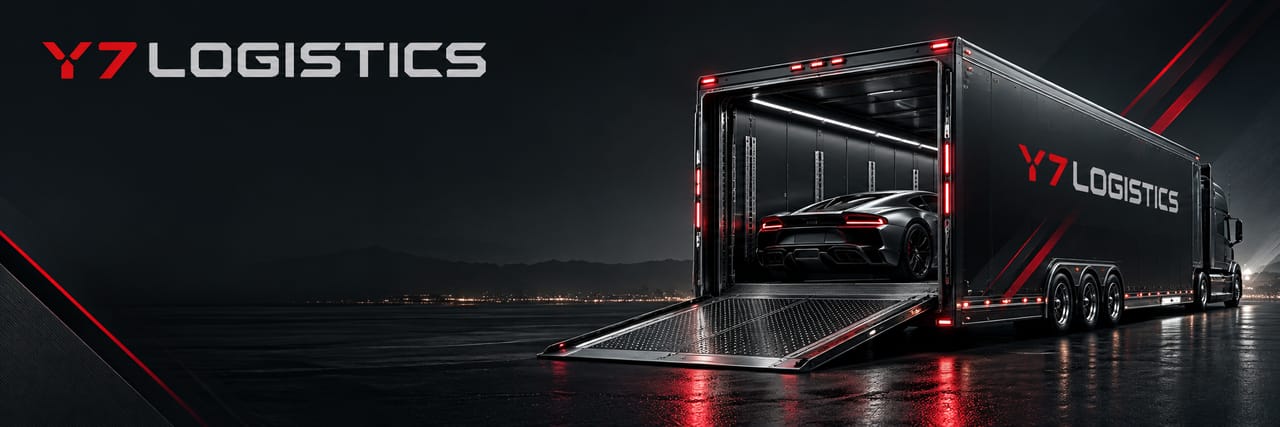
An enclosed auto transport trailer is a fully covered haul rig that holds 2–6 vehicles protected from weather, road debris, stone chips, UV exposure, and outside visibility. Unlike open carriers — where 7–10 vehicles ride exposed on a double-deck trailer — enclosed transport carries fewer vehicles in a sealed environment, and the carrier spreads fewer operating costs across them. That math drives the 40–60% price premium.
Enclosed trailers split into two main designs. Hardside enclosed trailers use rigid aluminum or steel walls and a solid roof — the maximum-protection option, completely weather-sealed, invisible from outside. Softside enclosed trailers use a rigid frame with heavy-duty canvas or coated-fabric side panels; lighter and occasionally cheaper, but slightly less protective against extreme weather and debris. For six-figure vehicles, hardside is the default.
Capacity also splits the market. Single-vehicle enclosed transport (one car per trailer) is the top tier — used for museum-grade classics, record-setting auction purchases, and any vehicle where contact with another car during loading is unacceptable. Multi-car enclosed (4–6 vehicles per trailer) is the more common option for luxury daily drivers, new-to-you exotics, and dealer-to-collector deliveries. Multi-car enclosed uses internal dividers and dedicated tie-down points to keep vehicles isolated during transit.
When to Choose Enclosed Transport
Most shipments should go open. But certain vehicles and certain situations make enclosed the clear choice. Here is how to think through it:
Luxury vehicles over $50,000
The rough industry threshold. Above $50K — Mercedes S-Class, BMW M-series, Porsche 911, high-trim Audis, Lexus LC, Range Rover — enclosed starts to make sense. The premium over open is small relative to the protection value, and resale condition matters more at this price point.
Classics, vintage, and collector cars
Pre-1990 collector vehicles almost universally ship enclosed. Original paint, period interiors, and irreplaceable trim are vulnerable to road exposure in ways newer vehicles are not. A 1967 Corvette, a 1970 Porsche 911, a 1985 Ferrari Testarossa — these are enclosed shipments, always.
Exotic and performance cars
Ferrari, Lamborghini, McLaren, Porsche GT variants, Aston Martin, Bugatti — the pure-exotic segment. Low ride height alone often disqualifies open trailers (the ramp angle is too steep). Combined with paint value, resale sensitivity, and the visibility concerns of parking a million-dollar car at a truck stop, enclosed is non-negotiable.
Show cars and new-delivery vehicles
Any vehicle going to a concours event, a trade show, or a customer as a brand-new delivery ships enclosed. The first impression matters, and arriving with road-dust and bug-splatter defeats the purpose.
Low-clearance vehicles
Any car with ground clearance under roughly 5 inches — many modern supercars, track-prepped vehicles, air-suspension cars stuck in low mode, vehicles with oversized front splitters — needs liftgate enclosed transport to avoid ramp contact. This is an equipment decision, not just a value decision.
Cost Comparison: Open vs Enclosed
The rule of thumb: enclosed costs 40–60% more than open on the same lane. Open rates run $0.40–$0.70 per mile; enclosed rates run $0.70–$1.20 per mile; single-vehicle top-tier enclosed can hit $1.50+ per mile on longer lanes. Carrier prices are not fixed: they spike and dip with fuel prices, season and driver availability, so treat these figures as a guide, not a quote. Here is a realistic comparison:
| Route Length | Open | Enclosed Multi-Car | Single-Vehicle Top-Tier |
|---|---|---|---|
| Under 500 mi | $400–$700 | $650–$1,100 | $900–$1,500 |
| 500–1,000 mi | $500–$900 | $800–$1,400 | $1,200–$2,000 |
| 1,000–1,500 mi | $700–$1,100 | $1,100–$1,700 | $1,700–$2,600 |
| 1,500–2,500 mi | $900–$1,400 | $1,400–$2,200 | $2,200–$3,400 |
| Coast-to-coast (2,800+ mi) | $1,100–$1,500 | $1,800–$2,500 | $2,800–$4,500 |
Prices move with fuel, season and driver availability; a guide, not a quote. A practical example: shipping a 1967 Corvette from Boston to Los Angeles, roughly 3,000 miles. Open transport is not an appropriate option for a vehicle of that vintage and value. Multi-car enclosed quotes typically land around $2,200, with transit typically 7–12 days after dispatch (a typical time, not a promised window). Single-vehicle top-tier enclosed with climate control and soft-tie straps runs closer to $3,500 with similar transit. The $1,300 difference buys dedicated routing, no shared-trailer contact, and climate regulation — often worth it for a vehicle of that era.
Types of Enclosed Trailers
Four equipment decisions affect enclosed transport pricing and suitability:
Hardside vs softside
Hardside enclosed trailers have full metal walls and a solid roof — complete weather seal, total privacy, and the highest debris protection. Softside trailers have a rigid frame with heavy-duty canvas or coated-fabric panels; slightly lighter and sometimes marginally cheaper, but less protective in sustained bad weather. For exotics, classics, and show cars, hardside is the default. For luxury daily drivers, softside is often acceptable and saves a small amount.
Single-vehicle vs multi-car enclosed
Single-vehicle enclosed is the top tier — one car, one trailer, dedicated routing. Multi-car enclosed (4–6 vehicles) is more common and more affordable; vehicles are separated by internal dividers and secured to dedicated tie-down points. For any vehicle where another car's door ding-equivalent at pickup is unacceptable, pay for single-vehicle.
Liftgate vs ramp loading
Ramp loading is the standard — a simple angled ramp off the back of the trailer. Works for any vehicle with roughly 5+ inches of ground clearance. Liftgate loading uses a hydraulic platform that lowers flat to the ground and raises the vehicle onto the trailer. Required for low-clearance supercars, air-suspension vehicles, or anything with an aggressive front splitter. Liftgate equipment typically adds $100–$300 to the quote.
Climate-controlled enclosed
A subset of single-vehicle specialty carriers offer climate-controlled trailers — regulated temperature and humidity during transit. Matters most for pre-1980 classics with period interiors, fresh paint jobs still curing, and long-duration moves where extreme temperature swings could affect the vehicle. Adds 15–25% on top of the single-vehicle enclosed rate.
Insurance and Handling Standards
Enclosed carriers handle higher-value loads than open carriers, and their insurance coverage and handling protocols reflect that. The differences matter when you are comparing quotes:
Insurance coverage
Open auto carriers typically carry $100,000–$250,000 in cargo insurance. Enclosed specialty carriers commonly carry $250,000–$500,000 because their cargo is routinely six-figure vehicles and their underwriters require it. (The $750,000 figure sometimes cited is the federal FMCSA minimum for liability insurance, which covers bodily injury and property damage; carriers typically carry $1,000,000. Liability is a separate policy from cargo coverage.) For declared values above $250,000 we confirm the specific cargo policy limit before dispatch; for concours or auction-record vehicles we can arrange supplemental coverage on top of the carrier's policy.
Soft-tie straps, never chains
Every enclosed shipment in our network uses soft-tie wheel-net straps that loop through the wheels and tension to anchor points on the trailer. The straps never touch the body, frame, or drivetrain. Chains directly on axles — a hallmark of older, lower-standard equipment — are not used on any shipment we dispatch.
Loading and unloading protocol
Enclosed carrier drivers are typically more experienced than open-carrier drivers — specialty transport pays better and attracts career operators. Expect a careful walk-around at pickup, detailed BOL documentation of pre-existing condition (including tire-wall scuffs, wheel curb rash, and paint chips smaller than a dime), and a matching walk-around at delivery. Take your own photos at both ends regardless — it is the single best habit for protecting yourself on any shipment.
Climate considerations for classics
For pre-1980 vehicles with original interiors, a climate-controlled enclosed trailer protects against leather drying, vinyl cracking, and wood-trim movement during long-duration cross-country moves through temperature extremes. For post-1990 luxury and exotic vehicles, standard enclosed is typically sufficient — modern materials handle temperature swings well.
When You Need This
- Luxury vehicles valued over $50,000
- Classic, vintage, and antique cars (pre-1990 collector vehicles)
- Exotic sports cars — Ferrari, Lamborghini, McLaren, Porsche GT models, Aston Martin
- Show cars and concours-condition vehicles
- Brand-new vehicles with zero delivery miles
- Low-clearance vehicles that cannot load on a standard open trailer
- Any vehicle where weather, debris, or visibility must be eliminated
How It Works
What You Need
- Vehicle year, make, model, and VIN
- Declared value for supplemental insurance
- Pickup and delivery locations
- Running or non-running status
- Ride height and any loading constraints (low splitter, air suspension, etc.)
- Preferred equipment type (hardside, softside, single-car, climate-controlled)
Our Capabilities
Frequently Asked Questions
How much more does enclosed shipping cost vs open?
Enclosed runs 40–60% more than open transport on the same lane. Open rates are typically $0.40–$0.70 per mile; enclosed runs $0.70–$1.20 per mile. A coast-to-coast open move at $1,300 becomes roughly $2,000–$2,200 enclosed. Single-vehicle top-tier enclosed can exceed $1.50 per mile on longer lanes. Carrier prices are not fixed: they spike and dip with fuel prices, season and driver availability, so treat these figures as a guide, not a quote.
When is enclosed transport worth the extra cost?
Enclosed is worth it for vehicles over $50,000, classic or collector cars, exotics, show-condition vehicles, brand-new zero-mile deliveries, low-clearance sports cars that need liftgate loading, and any time you want to eliminate weather and road-debris exposure entirely. Below the $50K threshold, open is usually the smarter choice.
What is the difference between hardside and softside enclosed trailers?
Hardside trailers have full metal walls and roof — complete weather seal, total visual privacy, and maximum debris protection. Softside trailers have a rigid frame with heavy-duty canvas sides; slightly lighter, occasionally cheaper. Hardside is the gold standard for exotics, classics, and show cars.
Liftgate vs ramp loading — which do I need?
Ramp loading is standard on most enclosed trailers and works for any vehicle with normal ground clearance (roughly 5+ inches). Liftgate (hydraulic platform) loading is required for low-clearance supercars, vehicles with air suspension that cannot raise, and any car with a front splitter or diffuser at risk of ramp contact.
Do enclosed carriers offer climate control?
Some do, particularly single-vehicle specialty carriers serving the classic and vintage market. Climate-controlled enclosed transport regulates temperature and humidity during transit, which matters for vehicles with period-correct interiors, delicate paint finishes, or long-term storage before transport. Expect an additional 15–25% premium.
What insurance coverage do enclosed carriers carry?
Cargo insurance on network carriers is typically $100,000–$250,000 for open transport and $250,000–$500,000 for enclosed, which is what matters for your shipment. (The $750,000 figure you may see elsewhere is the federal FMCSA minimum for liability insurance, which covers bodily injury and property damage; carriers typically carry $1,000,000. Liability is a separate policy from cargo coverage.) For declared values over $250,000, we recommend confirming the specific cargo policy limit before dispatch and can arrange supplemental coverage if needed.
Ready to get started?
Transparent pricing, carriers checked before each dispatch, fast dispatch response.
Get an Enclosed Quote